

Insights on pigmy banking, cooperatives, and financial inclusion.
Choosing the Right Pigmy Scheme for Your Cooperative Bank
Pigmy collection works best when the scheme matches how your members actually earn money. A daily pigmy scheme is natural for a market vendor or daily-wage worker; it may be burdensome for a farmer who earns in seasonal cycles. Choosing the wrong scheme leads to collection gaps, member drop-off, and the supervision overhead of chasing missed deposits.
This guide walks through the main pigmy scheme types and the questions that should drive your decision for each member segment.
Daily Pigmy: High-Frequency, Low-Amount
In a daily pigmy scheme, agents visit members every working day and collect a fixed small amount — typically between ₹20 and ₹200. The fixed nature keeps accounting simple; the daily frequency keeps members engaged with the savings habit and gives the bank high collection visibility.
Best suited for: Daily-wage workers, street vendors, small shop owners, market traders — members with daily cash income who benefit from a disciplined daily savings routine.
Collection efficiency: High. Regular visits build relationship familiarity and make anomalies immediately visible.
Challenges: Requires high agent capacity. Daily routes are demanding, and member holidays or travel create gaps that require follow-up. Works best in compact, walkable collection areas.
Weekly Pigmy: Balanced Frequency
Weekly schemes collect on one fixed day per week. Amounts are typically higher than daily schemes, and the lower frequency reduces agent workload while maintaining reasonable collection discipline.
Best suited for: Small business owners, salaried workers with weekly payment cycles, members in more dispersed geographic areas where daily visits are logistically difficult.
Collection efficiency: Moderate to high. The weekly rhythm is easy for members to remember, and agents can serve larger geographic areas. Missing a week is more significant than missing a day — so agents and members tend to prioritize weekly collection days.
Challenges: Monthly reconciliation has fewer data points than daily schemes, making anomalies slightly harder to catch early.
Flexible / Voluntary Pigmy: Member-Controlled
Some cooperative banks offer schemes where members deposit whenever they can, without a fixed schedule. The agent visits regularly, but the amount varies by the member's cash position.
Best suited for: Agricultural workers and farmers with seasonal income patterns, members in industries with variable cash flow, members who want to save but cannot commit to a fixed amount or frequency.
Collection efficiency: Variable. Requires more active agent judgment and member relationship management. Digital tools are particularly valuable here, as the irregular pattern makes paper-based tracking very difficult.
Challenges: More complex to reconcile; harder to set targets; requires agents with good member relationship skills. Not suitable for member segments that need external discipline to save consistently.
Mixed Schemes: Segmenting Your Member Base
Many cooperative banks run multiple scheme types simultaneously, matching the scheme to the member's income pattern. This is operationally more complex but produces better outcomes across a diverse member base.
EzPigmy supports multiple scheme types in a single system. Each member's account carries their scheme parameters, and the app shows agents the expected amount for each member they visit. The dashboard lets managers analyze collection performance separately by scheme type.
Key Questions to Ask
What is the primary income pattern of your target members? Daily income → daily scheme. Weekly/monthly wages → weekly scheme. Seasonal income → flexible scheme.
How large is your collection area? Compact urban area → daily scheme is feasible. Dispersed rural/semi-urban → weekly scheme reduces agent travel time.
What is your reconciliation capacity? Higher-frequency schemes require more granular daily reconciliation. If your branch is understaffed, a weekly scheme may be more manageable.
What is your members' savings discipline? Members who need external structure benefit from daily or weekly fixed-amount schemes. Members with good financial discipline can handle flexible schemes.
Using EzPigmy Across Scheme Types
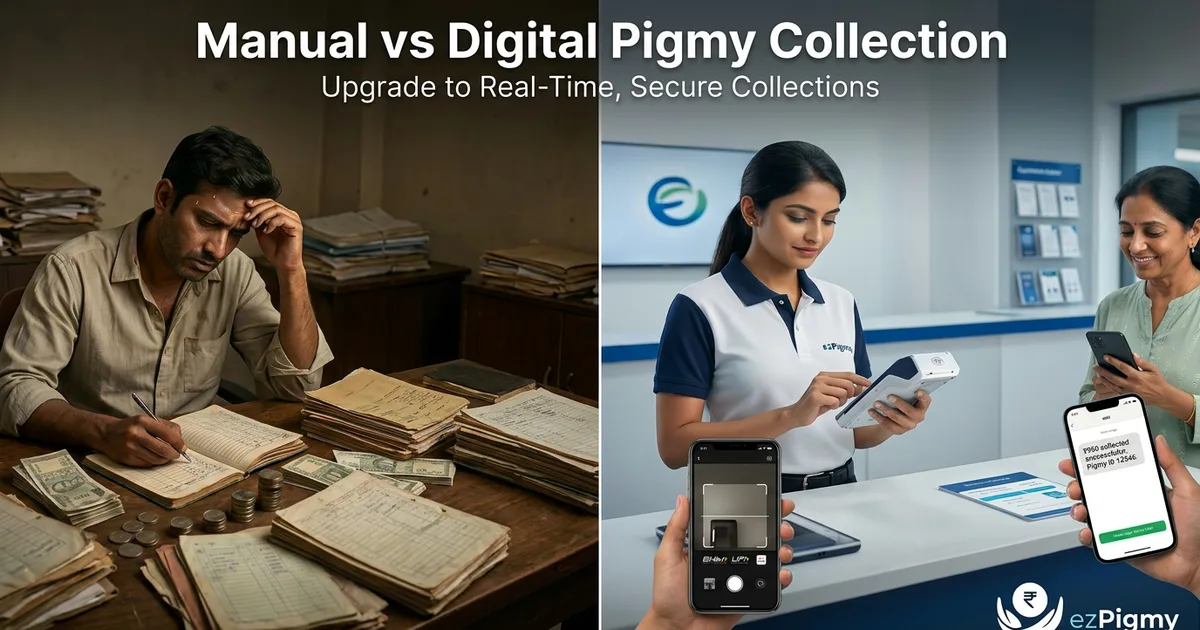
EzPigmy's collection screen shows each agent the expected deposit for each member, based on their scheme parameters. If a member is on a daily ₹50 scheme, the app defaults to ₹50 and confirms immediately. If the amount differs, the agent notes it and the system flags it for manager review.
This works the same way whether you're running daily, weekly, or mixed schemes — the scheme parameters are on the account, not hard-coded into the agent's workflow.
Need help choosing the right scheme structure for your member base? Contact our cooperative banking specialists for a consultation.
Related posts
ezPigmy
Ready to Digitize Your Pigmy Collection?
See how ezPigmy helps cooperative banks eliminate leakage, track agents in real time, and reconcile instantly.
Request a Free Demo