

EzPigmy vs Traditional Pigmy System: Which Is Better?
Cooperative banks across India have relied on the pigmy system for decades — a trusted savings scheme where field agents collect small daily or weekly deposits from members at their doorsteps. It builds financial discipline among members and generates steady, low-cost deposit inflows for banks. But as member expectations rise and regulators demand better audit trails, one question is becoming unavoidable:
Is the traditional manual pigmy system still fit for purpose?
This article compares the traditional pigmy model with EzPigmy — a purpose-built digital pigmy collection platform — across eight critical dimensions to help cooperative bank managers make an informed decision.
What Is the Traditional Pigmy System?
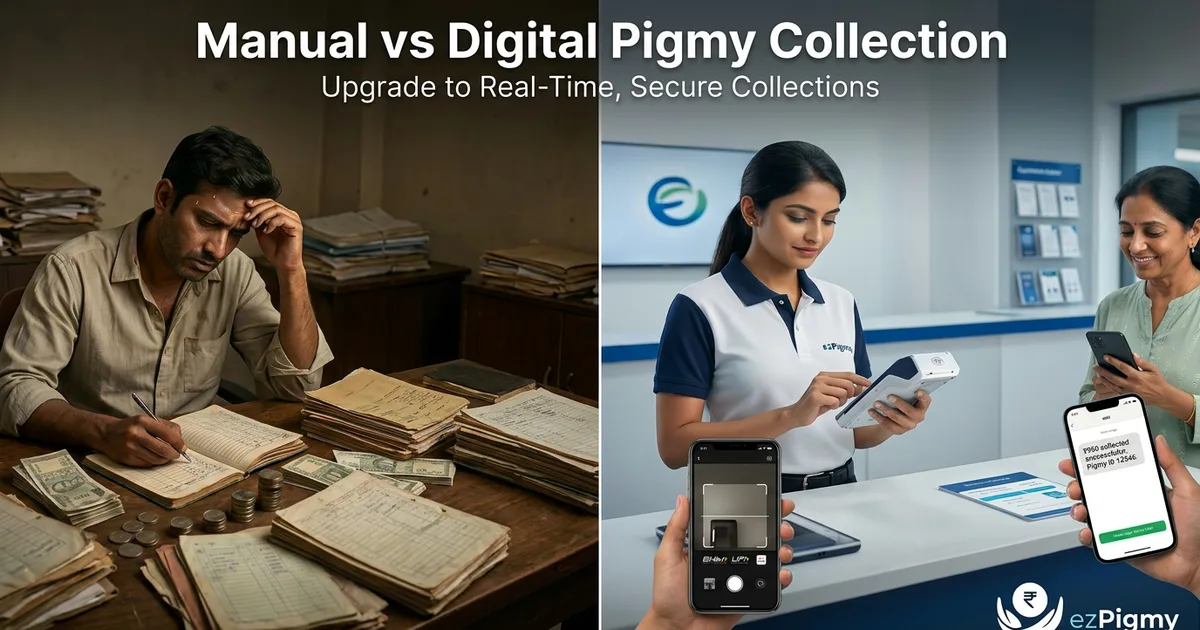
In the traditional model, a field agent (also called a pigmy collector) visits members daily or weekly, collects a fixed deposit amount, and records the entry in a physical passbook and a personal ledger. At end-of-day, the agent returns to the branch, deposits the collected cash, and the entries are manually reconciled with the ledger books.
This system was designed for a world without smartphones, real-time connectivity, or cloud databases. For decades it served cooperative banking admirably. But it carries structural risks that compound as an institution grows — risks that, left unaddressed, can erode both member trust and the bank's own financial integrity.
Pain Points of the Traditional System
Agent fraud risk is the most serious operational threat. There is no real-time check between what an agent collects in the field and what is deposited at the branch. A dishonest agent can pocket collections for days — sometimes weeks — before the discrepancy surfaces in month-end reconciliation. By then, members are upset, money may be unrecoverable, and the bank faces both a financial loss and a reputational crisis.
Zero real-time visibility means that branch managers and supervisors are always flying blind. There is no way to know, at any given moment, how many members have been visited, how much has been collected, or whether a particular agent is on schedule. Oversight only happens after the fact — and problems only surface during reconciliation.
Manual entry errors are an everyday reality. Handwritten ledger entries lead to transposition mistakes, missed entries, and amount mismatches. A digit transposed in a passbook can take hours to investigate and resolve — time that neither staff nor members have.
Physical passbook dependency creates fragility. The member's passbook is their only proof that deposits have been received. If a passbook is lost, damaged in a flood, or deliberately misplaced by a bad actor, there is no independent record to fall back on. Disputes become difficult — and sometimes impossible — to resolve.
No audit trail makes compliance increasingly difficult. Reconstructing a member's deposit history from physical ledgers is time-consuming and error-prone. Regulatory inspectors require structured, queryable records; stacks of handwritten books do not meet that bar.
Scalability ceiling — growing the pigmy portfolio means hiring more agents, training them, and trusting them with cash. Each new agent is both an operational asset and a risk exposure. The model does not scale cleanly.
Low member confidence persists because members have no independent means to verify that all their deposits have been correctly recorded. They must simply trust that the agent and the ledger agree — a leap of faith that erodes over time, particularly after any fraud incident.
What Is EzPigmy?
EzPigmy is a digital pigmy collection platform built specifically for cooperative banks and credit societies. It replaces physical ledgers and passbooks with a secure, cloud-connected Android app that field agents use to record every collection the moment it is made.
The platform is not a generic fintech tool retrofitted for pigmy banking — it was designed from the ground up for the cooperative banking context, with a feature set that directly addresses the pain points of the traditional system.
How EzPigmy Works
Instant digital collection entry: When an agent visits a member, they open the EzPigmy app, select the member's account, enter the deposit amount, and confirm. The entry is timestamped, tagged with the agent's identity and device, and synced to the cloud immediately. There is no batch processing, no end-of-day accumulation of risk.
Built-in thermal receipt printing: EzPigmy runs on a rugged Android handheld with an inbuilt thermal printer — no separate printer to carry, pair, or charge. The moment a deposit is confirmed in the app, a formatted receipt is printed directly from the device and handed to the member. The receipt looks and feels like a bank-issued receipt — it carries the transaction ID, amount, date, and member details. Members walk away with proof in hand.
Live branch dashboard: Back at the branch, supervisors and managers see real-time collection data — agent-wise totals, member-level status, pending collections, and daily summaries — without waiting for agents to return. If an agent is behind schedule or a collection looks anomalous, managers can intervene in real time rather than discovering problems at end-of-day.
Complete and tamper-proof audit trail: Every transaction in EzPigmy carries the agent ID, device ID, timestamp, and GPS coordinates of where the entry was made. This log cannot be edited or deleted by the agent. Any discrepancy between what was recorded and what was deposited is immediately visible and traceable to a specific agent, time, and location.
Multi-branch support: EzPigmy's security model enforces strict data isolation between branches. A cooperative bank operating across twenty branches gets consolidated visibility at the head-office level, while supervisors at one branch cannot access another branch's records. This makes EzPigmy suitable for district-level cooperative banking structures.
Offline-capable Android app: Field agents often work in areas with poor connectivity — rural outskirts, basement apartments, industrial zones. EzPigmy queues collections locally when connectivity is unavailable and syncs automatically once the device reconnects. No collection is lost to a network outage.
EzPigmy vs Traditional Pigmy System: Side-by-Side Comparison
| Dimension | Traditional Pigmy System | EzPigmy Digital Platform |
|---|---|---|
| Collection recording | Manual entry in passbook and agent ledger | Instant digital entry via Android app |
| Receipt generation | Handwritten or stamped slip | Digital record + inbuilt thermal print |
| Real-time visibility | None — only after end-of-day deposit | Live dashboard for supervisors and managers |
| Fraud prevention | Relies entirely on agent integrity | GPS-tagged entries + tamper-proof audit log |
| Data backup and safety | Physical ledgers — vulnerable to fire, flood, theft | Cloud-backed with automatic redundancy |
| Reconciliation | Manual, labour-intensive, error-prone | Automatic and real-time |
| Scalability | Limited by agent headcount and supervision capacity | Unlimited branches and agents on a single platform |
| Member confidence | Low — no independent verification possible | High — instant digital receipts and verifiable history |
6 Key Benefits of Switching to EzPigmy
1. Eliminate Agent Fraud at the Source
Because every collection is recorded and synced the moment it is made, there is no window for agents to manipulate figures. The system captures the agent, time, location, and amount for every transaction — making any discrepancy visible to supervisors before end-of-day. Fraud that previously went undetected for weeks surfaces immediately.
2. Real-Time Operational Intelligence
Branch managers no longer manage pigmy operations blind. EzPigmy's dashboard shows live collection progress, outstanding member accounts, agent performance metrics, and daily targets versus actuals. This enables proactive intervention — reassigning a struggling agent, following up on missed members — rather than reactive auditing after the damage is done.
3. Dispute Resolution in Seconds
When a member queries a missed collection, managers can pull up the full transaction history — agent, timestamp, GPS coordinates, and printed receipt ID — in seconds. What used to require sifting through physical ledgers for hours is resolved on a single screen. Members leave satisfied; staff spend less time in disputes.
4. Professional Member Experience
Members receive a printed thermal receipt at their doorstep, identical in format and feel to a bank-issued receipt. This professionalism builds trust, reduces anxiety about whether deposits have been properly recorded, and increases member retention. Members who feel confident about the process are more likely to increase their deposit amounts over time.
5. Built for Growth
Cooperative banks aiming to scale from 500 to 5,000 pigmy members do not need to scale their supervision overhead proportionally. EzPigmy handles multiple branches, thousands of members, and dozens of agents on a single platform — with consolidated reporting at each level. Growth becomes an operational strength, not a risk amplifier.
6. Regulatory and Audit Readiness
Digital transaction records, GPS logs, agent activity trails, and complete member histories give compliance teams and external auditors the structured, queryable evidence they need — exportable in standard formats rather than physical ledger pages. As cooperative banking regulation tightens, being audit-ready is no longer optional.
What Affects Pigmy Billing Machine Pricing?
Every cooperative bank's pigmy operation looks different, so pigmy billing machine pricing — sometimes searched as pygmy billing machine pricing — isn't one-size-fits-all. A few factors decide what a deployment costs:
Bundled platform vs. hardware alone: EzPigmy isn't just a handheld device — it's device, software, cloud dashboard, and support delivered as one platform. Pricing reflects the full platform, not a bare printer.
Number of field agents and devices: A cooperative bank running five agents has different infrastructure needs than one running fifty. Pricing scales with the size of your field force, not a flat per-branch fee.
Scale of the cooperative bank: Branch count, member base, and transaction volume all factor into the right deployment size — and the right pricing tier.
Support and consumables: Ongoing support, printer consumables, and device replacement or maintenance can be bundled in or handled separately, depending on what your bank needs.
Because pricing depends on your bank's specific footprint, the most accurate way to know what a pigmy (or pygmy) billing machine costs for your institution is to request a quote.
Ready to see pricing for your bank? [Request a Quote →]
The Verdict
The traditional pigmy system was built for a world without smartphones, cloud databases, or real-time connectivity. It served cooperative banking well for decades — but the trust deficit, audit risk, and operational ceiling it creates are increasingly difficult to justify as institutions grow and regulators demand more.
EzPigmy does not replace the agent relationship at the heart of cooperative banking. Doorstep collection remains the model's greatest strength — the personal touch that banks and ATMs cannot replicate. EzPigmy makes that relationship verifiable, scalable, and trustworthy. Members get receipts. Managers get visibility. Auditors get evidence. And banks get a pigmy portfolio they can grow with confidence.
Ready to see EzPigmy in action? Contact us to schedule a demo for your cooperative bank.
Frequently Asked Questions
Related posts
ezPigmy
Ready to Digitize Your Pigmy Collection?
See how ezPigmy helps cooperative banks eliminate leakage, track agents in real time, and reconcile instantly.
Request a Free Demo