

Why Agent UPI QR Codes Are a Reconciliation Trap — And What Smart Banks Are Doing Instead
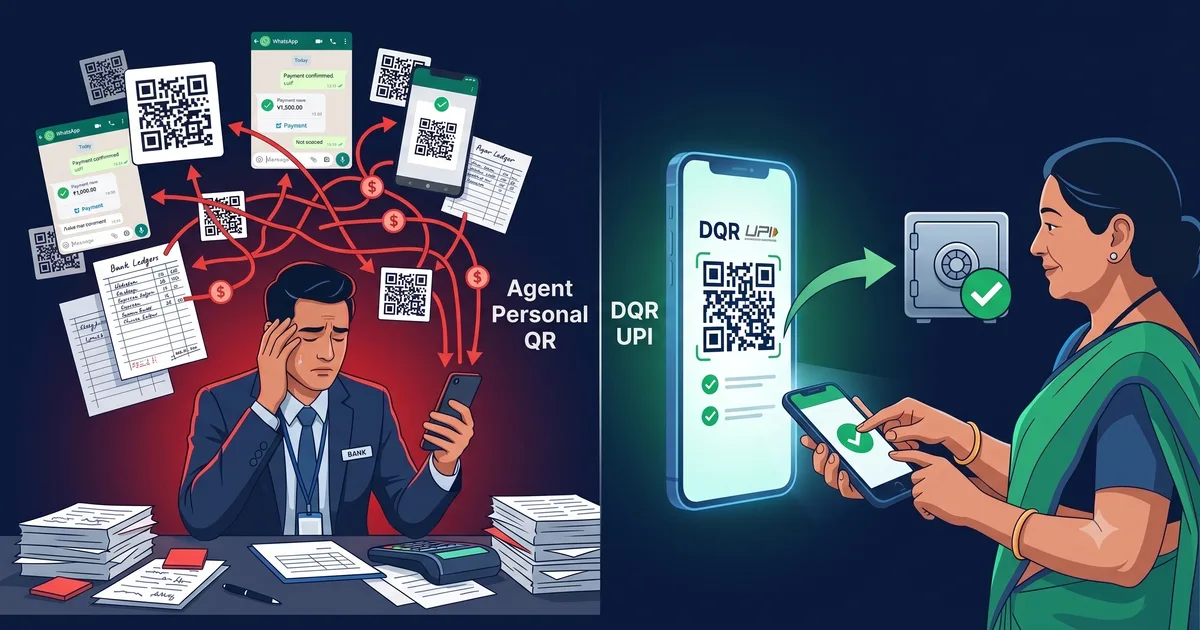
It is 6 PM. Your branch manager is still at her desk. The day's pigmy collection sheet shows ₹48,000 collected across 160 accounts. The bank's UPI ledger shows 94 credits totalling ₹28,500. The other ₹19,500? Somewhere between three agents' PhonePe accounts and a stack of WhatsApp screenshots she is trying to match by hand.
This is not a bad day. This is a Tuesday.
Across cooperative banks and NBFCs in India, the same scene plays out every evening. Field agents use their personal UPI QR codes to collect installments at the doorstep — a practical decision nobody formally approved that has quietly become the backbone of digital collection. It is convenient. It is fast. And it is creating a reconciliation and compliance problem that gets worse every month.
Some banks have moved to a shared static QR code in an attempt to fix this. It is better. It is not enough.
This post walks through exactly why agent personal QR codes fail, why static QR only half-solves the problem, and how Dynamic QR (DQR) UPI eliminates the issue at the source.
The 5 Problems with Agent Personal UPI QR Codes
1. Reconciliation Is a Daily Manual Nightmare
When a customer scans an agent's personal QR and pays ₹500, that money lands in the agent's personal bank account — not in your books. The branch sees nothing until the agent remits, which may happen that evening, the next morning, or after a few days depending on the agent's habits.
Matching each remittance to the right customer account is entirely manual. Agents send screenshots. Branch staff cross-reference names, amounts, and timestamps against collection registers. If an agent collected from 30 customers in a day and sent a single bulk transfer, the branch has to reconstruct which ₹500 belongs to which account.
At scale — 20 agents, 600 daily transactions — this becomes an end-of-day accounting exercise that consumes hours of staff time, every day, with no guarantee of accuracy.
2. Fraud and Embezzlement Have No System-Level Check
When a customer pays via UPI and the confirmation goes to the agent's personal phone, only the agent knows it happened. There is nothing stopping an agent from recording that collection as cash, or not recording it at all, and keeping the UPI credit.
Without a system-level record that links the UPI transaction to the customer's account at the point of collection, the bank has no authoritative trail. If a discrepancy is discovered weeks later, the agent's account shows a transaction. The bank's records show a cash entry. There is no mechanism to determine which is correct.
This is not a theoretical risk. It is the reason fraud in field collection operations typically goes undetected for months.
3. Float Sits in Agent Accounts, Not Yours
Between collection and remittance, funds pool in agents' personal bank accounts. Depending on remittance frequency, a moderately active agent may be holding ₹30,000–₹80,000 of member deposits at any given time.
This creates two problems. First, you have no visibility into your actual liquidity position — funds that belong to your members are sitting in accounts you cannot see or control. Second, agents earn float on money that is not theirs. In some cases, agents exploit remittance delays deliberately.
Most banks have policies about same-day remittance. Without system-level enforcement, a policy is only as reliable as the agent who chooses to follow it.
4. Audit and RBI Compliance Cannot Be Demonstrated
When an RBI examiner or internal auditor asks to trace a specific UPI credit to its source — which account it came from, which agent collected it, which customer it represents — your system cannot answer that question.
The payment happened on an agent's personal account. The remittance arrived as a single transfer. The original UPI reference is gone. What remains is a handwritten register entry, a WhatsApp message, and a memory.
RBI's guidance on IT governance for cooperative banks expects banks to demonstrate transaction-level audit trails for digital collection. "The agent used their personal phone" is not an answer that satisfies an examiner. Findings on this specific point have been issued to multiple institutions.
5. Customer Disputes Become Unresolvable
A customer pays ₹500 via UPI. The agent, for whatever reason, does not record it — or records ₹300. The customer shows you a UPI success notification from their phone. The agent denies the discrepancy.
You have no authoritative record on the bank's side. The customer's phone says one thing. The agent's verbal account says another. You cannot adjudicate this with confidence, so you either absorb the loss or damage a customer relationship.
Disputes of this kind are small individually. Collectively, they represent eroded member trust — and periodic large losses when the discrepancy is significant.
Why a Static Org QR Code Only Half-Solves the Problem
Faced with these issues, many banks have issued a single organization-level UPI QR code for their agents to use. Money now lands directly in the bank's account instead of the agent's. Fraud and float risks are largely addressed.
The reconciliation problem remains entirely unsolved.
When 200 customers scan the same QR and pay across a single day, the bank receives 200 UPI credits — all to the same VPA, all with no structured reference. Someone still has to match each ₹500 credit to the right passbook account.
UPI's remarks field theoretically allows customers to type an account or member number as a reference. In practice, this fails constantly. Customers leave it blank. They type names instead of numbers. They type the wrong number. Agents forget to instruct them. Every error is a manual investigation.
A shared static QR also provides no per-agent accountability. If five agents use the same QR across three branches, the bank cannot tell which agent collected which payment. The agent-level audit trail — a basic operational requirement — does not exist.
Static QR moves the money to the right institution. It does not solve the identity problem.
How DQR UPI Fixes This at the Source
Dynamic QR (DQR) UPI works differently at every step of the collection process.
When an agent starts a collection for a specific customer in the ezPigmy app, the app generates a unique QR code for that customer's account, for that collection, at that moment. The QR encodes the exact amount, the customer's account reference, and the agent's identity. The agent shows this QR to the customer. The customer scans and pays.
The payment lands directly in the bank's account — not the agent's. Simultaneously, the system posts the credit automatically to the correct customer account. No manual matching. No reconciliation queue. No end-of-day chase.
Here is how DQR addresses each of the five problems:
Reconciliation — Every UPI credit is tagged to a specific customer and account at the moment of generation. The system reconciles automatically. Branch staff do not touch it.
Fraud — The agent cannot collect to a personal account. The QR is generated by the bank's system. The money goes to the bank's account. The transaction record exists on the bank's side before the customer even scans.
Float — Funds go directly from the customer's account to the bank. There is no intermediate stop in the agent's wallet. There is no float, because there is no holding period.
Audit trail — Every transaction carries a complete record: which agent generated the QR, which customer it was issued for, which account it maps to, the exact timestamp, and the UPI reference. This is exportable and regulator-ready on demand.
Customer disputes — The system record is authoritative. If a customer paid, the transaction is in the system. If the amount differs from what the agent recorded, the discrepancy is immediately visible. There is no "he said, she said" — there is a ledger entry.
Comparing the Three Approaches
| Agent Personal QR | Static Org QR | DQR UPI (ezPigmy) | |
|---|---|---|---|
| Reconciliation | Manual, daily chaos | Still manual | Automatic |
| Fraud risk | High — no system check | Low — money hits bank | Eliminated |
| Float in agent accounts | Yes | Eliminated | Eliminated |
| Audit trail | None | Partial (bank side only) | Complete |
| Customer disputes | Unresolvable | Difficult | System record wins |
| Per-agent accountability | None | None | Full |
If your team is still spending hours every evening reconciling UPI credits against collection registers, you are solving a problem that should not exist. The technology to eliminate it is already running in production.
Want to see how DQR UPI works for your branch operations? Book a free demo →
Related posts


ezPigmy
Ready to Digitize Your Pigmy Collection?
See how ezPigmy helps cooperative banks eliminate leakage, track agents in real time, and reconcile instantly.
Request a Free Demo